Understanding Paints & Tools
What different paint types do and which brushes actually matter
~5 min read
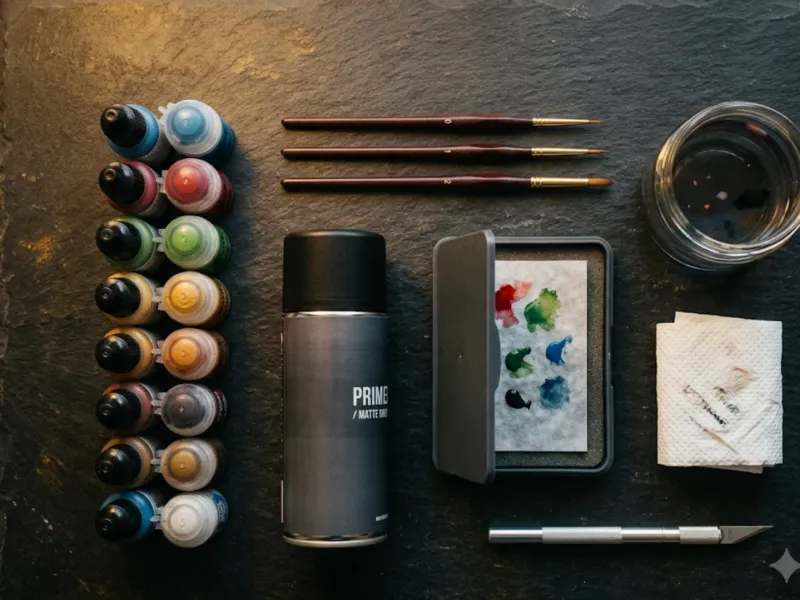
Paint Types Explained
Nearly all miniature paints are acrylics (oils and enamels exist for weathering, but that's a later adventure), and they come in several types designed for specific jobs. Understanding what each type does helps you pick the right paint for the right situation — and stops you from buying paints you don't need yet.
- Base / Opaque paints — high-pigment paints designed for solid coverage in one to two coats. These are your workhorses for laying down flat color on a primed model.
- Layer paints — slightly thinner and more translucent than base paints. Designed for building up highlights and transitions on top of a basecoat without obscuring detail.
- Shade / Wash paints — very thin, dark, translucent paints that flow into recesses through capillary action. Apply them over a basecoat to instantly create shadows and define detail.
- Contrast / Speed paints — all-in-one paints that act as basecoat, shade, and highlight when applied over a white or light primer. Perfect for getting models table-ready fast.
- Dry paints — thick, chalky paints designed specifically for drybrushing. They stick to raised surfaces without flowing into recesses.
- Technical paints — specialty paints for specific effects: texture pastes for bases, blood effects, rust, verdigris, and more.
As a beginner, you need base paints and a wash or two. That's it. Layer paints, contrast paints, and technical paints are nice to have but absolutely not required to paint great-looking models.
Brushes That Matter
You don't need a huge collection of brushes. Most painters use two or three brushes for ninety percent of their work. A size 1 or size 2 round brush with a good point handles basecoating and detail work. A size 0 handles fine details like tiny insignia — though a quality size 1 with a sharp point can paint eyes too, and holds far more paint than a 00. And an old, beat-up brush handles drybrushing and applying texture paste to bases.
- Size 1 or 2 round — your main brush for almost everything
- Size 0 or 00 — for fine details only
- An old or cheap brush — for drybrushing, stippling, and messy work
- A large flat brush — optional, useful for priming and terrain
Brush care tip: never let paint dry in the bristles (especially near the ferrule where the bristles meet the metal). Rinse frequently while painting, and clean brushes with brush soap at the end of each session. A well-maintained cheap brush outperforms a neglected expensive one.
Sign in to track your progress